
Storyline
The War on Bitcoin Mining
The war on Bitcoin mining is the Bugleverse’s longest-running argument about proof of work, and its distinguishing feature is that The Bugle Weekly is not on the defending side. Where the outside world treats mining’s energy use as an accusation, Richard Greaser and Rod Palmer treat it as a policy opportunity: the warming is real, it is deliberate, it is good, and the correct response is to subsidise it, tax the people who aren’t doing it, and staff a federal cabinet with the men who own the machines. The war’s enemies are rarely environmentalists. They are, in order of airtime, uncompliant miners, tall Canadians, and men with no hash rate.
Who’s in it: Richard Greaser · Rod Palmer · Steve Barbour · Fred Thiel · Jason Lowery · Dennis Porter · Harry Sudock · Peter Todd · Jyn Urso
The subsidy thesis (2024)
The arc opens as economics. In Comply Side Economics 101, Greaser resolves Bitcoin’s security budget in one stroke — the funder is the state: “that’s how we fix the security budget issue is the the US government.”1 Peter Todd, the real-world dissenter on that exact question, is waved off rather than answered: “Peter Todd just he he’s got things all mixed up.”2 Greaser also claims Barnminer for the camp — “just like Barn Miner, he he’s definitely on the compliance bandwagon with us” — though the beat is a boost read and the recruitment is asserted rather than confirmed by the man himself.3
The show’s labour politics arrive the following week, when the 40HPW slogan is transposed onto hashing: “reward, for forty hours a week. Nobody who hashes for forty hours a week should live in poverty.”4 The same episode carries the halving-truther story, in which an extremist group called the Havening beheads Charlie Spears for mining blocks fast enough to drag the halving date forward a day: “So had you heard of this extremist group called the Havening,“5
Intentional climate change
The war’s central doctrine is coined on air in episode 8, where Greaser identifies the crime committed by plebs heating their homes with miners: “they’re engaging in intentional climate change.”6 The phrase is not a defence. It is an admission the show is delighted to make, and everything downstream treats miner-caused warming as a real, deliberate and desirable output.
By Recovering From A Noncompliant 4th, Greaser has turned it into a counter-insurgency tactic: subsidise home mining widely enough and the warming disperses past the point where activists can find a target — “the Texas Coalition Against Bitcoin Mining freaking out about that, about the only intentional climate change.”7 The grid argument escalates in parallel. Asked whether mining balances the grid, Greaser declines the modest version: “does Bitcoin mining balance the grid, I think it’s the only thing thing that balances the grid. I think that, you know, without Bitcoin mining, the grid is super in balance.”8 Palmer later completes the inversion by removing the miners from the argument altogether — the relatives who once blamed Bitcoin podcasting for draining the local grid now understand “they realize that the Bitcoin podcasters are actually necessary for grid stability.”9
The climate case is eventually put out to tender. Palmer offers Jyn Urso the highest-paid lobbying job in Bitcoin mining for producing the research — “do research that shows that Bitcoin mining is good for climate change? Yeah. I really hope so.”10 — and the same episode closes the loop entirely, with cigarette emissions pumping the price, the price funding the hash rate, and the hash rate offsetting the cigarettes: “from more people smoking cigarette would promote the Bitcoin price, which would make mining more profitable, which means that Bitcoin mining would fight”11
The charge, as reported
On air the phrase is a doctrine; on the Bugle‘s X feed it is a criminal charge, filed against named men in named jurisdictions. The feed treats “intentional climate change” not as an opinion to defend but as a statute already on the books, and its coverage is the police-blotter version of the same war — arrests, registries, amnesties, and pardons, reported straight.
The charge runs ahead of its coinage
The feed was filing the charge months before the show claims to have coined it. The earliest bulletin is the S9 raid, datelined November 2023 — the same headline the page’s Disputed note flags as predating Greaser’s on-air coinage by eighteen months:
“Police Raid Man’s Home For Heating It With S9, Charged With Intentional Climate Change” — @bitcoin_bugle, 2023-11-02
Pressed in the replies on whether intent could be proven, the account held the line prosecutorially — “based on his charges, they have to prove he intended to warm the climate.”12 By January the charge had grown a water count, the mining war’s rarely-aired second front — “Heating your house with Bitcoin miners is a terroristic activity. Not only are you participating in intentional climate change, but also using a ton of water.”
“Intentional climate change is horrendous. People should not be allowed to heat their houses with Bitcoin miners.” — @bitcoin_bugle, 2024-01-18

Henry’s note: the feed’s date order settles nothing the Disputed section leaves open — it merely confirms the phrase was in newsroom circulation well before episode 8 broadcast it. Whether that makes the on-air moment a coinage or a re-coinage is still not adjudicated by any source.
The Canadian front
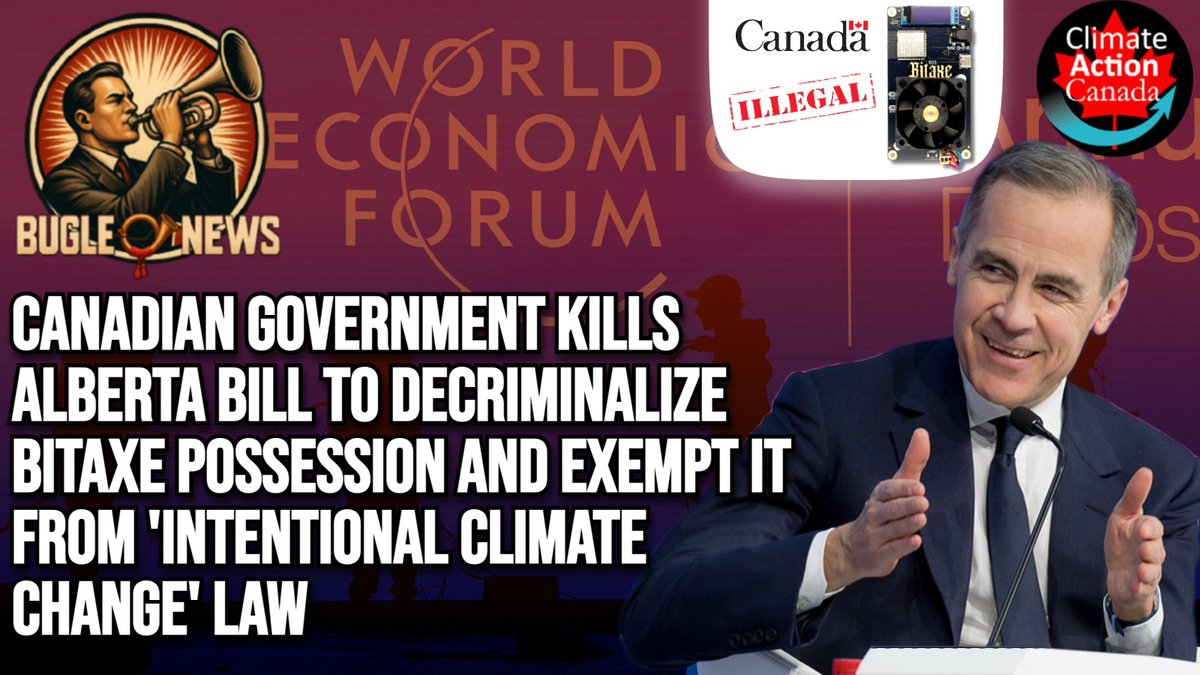
Canada is where the charge is enforced hardest, dovetailing with Trudeau vs Bitcoin Mining and the running Canada Watch. The advisories are protective in tone and menacing in substance — “Canadians, please do not buy these. You may get arrested for intentional climate change if you do.”13 The state’s mercy arrives as an amnesty, written up under Rod Palmer‘s byline: Canada “Allowing Bitcoin Miners to Surrender ASICs, ‘No Questions Asked’.”14 The crackdown then scales to the head of government, who closes a decriminalisation loophole in person:
PM Carney said, “Any act of Intentional Climate Change is criminal. No matter how small” — @bitcoin_bugle, 2025-05-20
Registration is the trap
The feed’s cruelest recurring bit is that compliance is itself the offence: registering a machine is what triggers the charge. The registry is a honeypot — “Once miners register their hashing computers, they will then be charged with intentional climate change. This is going to go down hill fast.”15 The gag has a mascot, the Florida man who does the paperwork correctly and is arrested for it: “Florida Man Registers S9 With EIA, Is Immediately Charged With Intentional Climate Change.”16 It is the police-blotter twin of Greaser’s on-air complaint about PodConf driving plebs to KYC their hash voluntarily.
Politicians file the charge
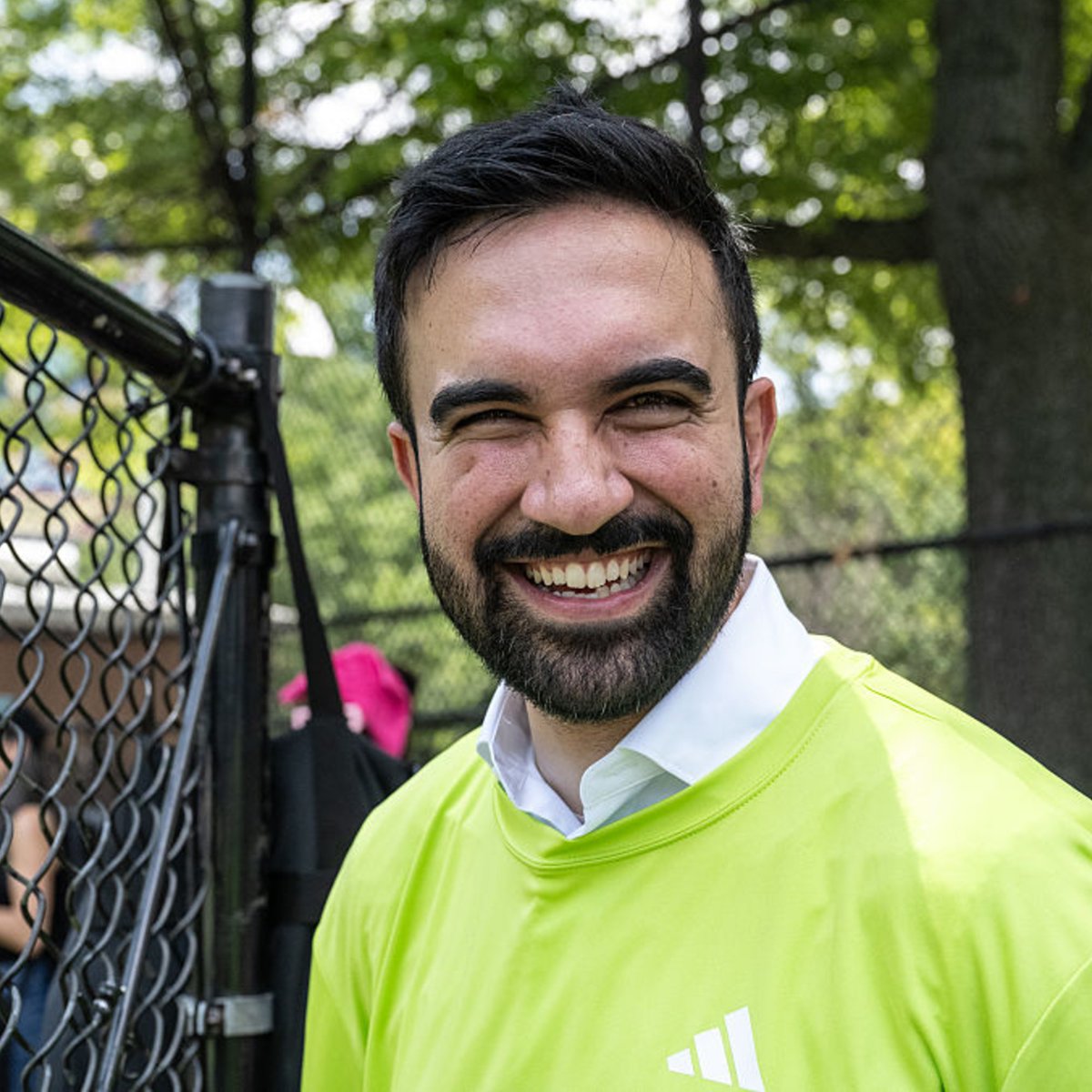
Every politician the feed casts is measured by their stance on the statute. The enemies enforce it; the mining war’s rare ally is the one who repeals it. In January 2025 the pardon arrives from the top — “President Trump: Bitcoin miners will henceforth be allowed to secure the timechain without fear of being charged with ‘Intentional Climate Change’.”17 By October the next enforcer is cast: a mayoral candidate promising to charge anyone caught running a BitAxe, and then, per the graphic, to fight them.
“ZOHRAN MAMDANI SAYS ANYONE CAUGHT RUNNING A BITAXE IN NYC WILL BE CHARGED WITH ‘INTENTIONAL CLIMATE CHANGE’ WHEN HE BECOMES MAYOR AND THEN THEY FIGHT YOU” — @bitcoin_bugle, 2025-10-19
Field discipline
Between bulletins the feed issues instructions to its own troops, and they cut both ways. On Earth Day it counsels tactical restraint — “consider turning off your miners to temporarily limit intentional climate change”18 — while in the ordinary course of business it solicits the opposite, asking plebs “causing intentional climate change at home with your S9s” to donate the surplus hash to the Bugle’s own pool.19 Greaser works the supply side personally, prodding a hardware vendor in the replies about “sending some more intentional climate change devices.”20 The charge, in other words, is one the show is recruiting people to commit.
Staffing the government
Mid-2024 the war goes electoral. Greaser reports that Jason Lowery is engaged with the Trump campaign for Treasury Secretary and would use the IRS to regulate mining and fees, with the large US miners taking control of the branches of the military: “one of the things Jason’s trying to do is as treasury secretary.”21 Palmer hedges the authorship on air — he does not know whether it is official policy or David Bailey‘s idea — and the cabinet draft’s method is confessed a week later, when Palmer nominates an energy secretary he can identify only by voice: “Harry Suddock. That guy Harry Suddock. I think Harry Suddock would be a good secretary of the energy.”22
Dennis Porter is the war’s admired technician. Palmer reads his Oklahoma mining bill not as legislation but as a slow assault on the legal code — “official legislative policies, and you just pepper the books with these nonbinding, meaningless policies, eventually,”23 Greaser credits Porter with mining not having been banned at all.
Legislative ambition survives the change of candidate. Palmer reads Kamala Harris‘s anti-price-gouging platform as fee policy, protecting plebs from miners “price gouging us on transaction fees”24 — with Greaser’s implementation being a Federal Reserve that arbitrarily raises and lowers the block size as a rate-setting mechanism.
The HODL tithe, and the troops
The show’s own legislative contribution is Greaser’s first Bitcoin improvement proposal, renamed live because the original word tested badly: “I titled it the HODL tax, but I I’ve been I’ve been floating around with rebranding it to the HODL”25 — tithe landing in the following cue. Greaser sources it to a Bitcoin Magazine article arguing hodlers owe fees to miners and reports that Jimmy Song applauded it. It returns as settled doctrine in episode 22, where the dead are the revenue base: hodlers who die without an orange-pilled heir fund the miners for eternity.26
Refusal to pay is framed as a failure of patriotism. Palmer’s equation is flat — “how important minors are. Like minors are the troops.”27 The same episode establishes the war’s physiology: “Like low hash rate is correlated with low testosterone,”28 which Greaser uses to predict the guest list at Robert Breedlove‘s alpha male conference on the grounds that only men with no hash rate would need it.
Mining’s diversity initiative arrives in the same run. Palmer reports the major pools now grant “women get one free high priority transaction into the mempool”29 every Thursday, capped at ten sats per vByte; Greaser declines to call it marketing — “that feminine hash rate, you know, to the network is is pretty I I would say it’s a pretty significant development.”30 His completed argument is that men will transition in order to get the fee waived, and that this too counts as getting more women into Bitcoin. The subsidy bit recurs two years later in California, where a state form’s first checkbox reportedly qualifies a pleb for the LGBTQ utility subsidy on rented hash: “One of the first check marks on the on the form is, Are you a plaid? And if you’re a plaid, renting ash, that”31
Miners the show is actually at war with
For a page about defending mining, the record is mostly hostile to miners. Greaser rejects PodConf‘s slogan for driving plebs to KYC their hash voluntarily: “the idea that compliance is defiance, but in reality, it isn’t.”32 Palmer’s standing verdict is blunter — “you have my feelings about miners, they’re Neanderthals, they don’t understand business,”33 the charge being that they hoard ASIC chips to centralise the network and lose money doing it when the chips could go to BitAxes.
Fred Thiel is the designated cautionary tale. Greaser first mislabels him as Peter Thiel and corrects himself by inventing a family relationship — “to protect the hodlers, to protect the the ordinals, to protect everything. I know I know Peter Thiel. Why did I say Peter Thiel?”34 — before landing the moral in episode 29: “And so I think there’s a lesson to be learned, which is don’t be like Fred Thiel.”35 The contrast is Steve Barbour, recalled as prior Bugle reporting for parking containers of miners outside Ottawa to punish politicians with noise after a proposed ban: “They were trying to ban Bitcoin mining up there, calling it intentional climate change.”36 Barbour aimed his machines at politicians; Marathon aims its at residents. Barbour nonetheless remains suspect for contradicting Porter, and appears at Christmas gaming Santa’s list on purpose: “Steve Barber intentionally gets on the naughty list for Santa every year because he, you know, he likes getting coal in his stocking.”37
The pool wars get one drive-by, and a hedged one. Greaser’s line — “if you don’t believe that people should eat cats, then just solo mine instead of using ocean.”38 — names nobody; the connection to Luke Dashjr rests on Palmer’s preceding remark about Knots, and is inference rather than statement. The surrounding segment has Greaser arguing that cheap BitAxe hash rate kills Peter Todd‘s security-budget argument, sourced to “credentialed journalist” Pete Rizzo.
Late war
The later beats run on the same engine at longer range. Palmer extends the stranded-energy thesis to medicine, making Sub-Saharan Africa the future of both because Bill Gates ships vaccines that never arrive: “the stranded they they have stranded energy and they have stranded vaccines.”39 Greaser answers quantum FUD with a hardware startup — “I tweeted about this. We need quantum bit access.”40 (quantum bit ASICs, per the ASR). And in November 2025 the sponsor’s product is retconned into a macroeconomic force: Trump’s failure to lower energy prices is the plebs’ fault, because trinkets are deploying faster than deregulation can cut prices — “of hyperbitcoinization is a plugged trinket in every home or multiple plugged trinkets. So I think that’s a that’s a, like, a bad campaign promise,”41
The war acquires an anthem in 2026, the miners’ answer record to securitised Bitcoin: “Every point you flex, every stack you flash came out of rigs. Run by some frontier trash.”42 The singer is not identified in the episode, and authorship of Frontier Trash and its follow-up Outlaw Hash is genuinely open.
Disputed
Who coined “intentional climate change,” and when. The beat index records the phrase as an on-air coinage by Greaser in episode 8, 13 May 2024, escalated immediately by Party Bent into the house as a microcosm of the planet.6 But the Bugle’s own archive carries it in a headline eighteen months earlier, under Greaser’s byline.43 Both readings are live: either the show is mis-crediting a coinage to its own broadcast, or Greaser is re-coining a phrase he had already printed. The record does not adjudicate it, and no beat has a host acknowledging the earlier piece. The X feed (see The charge, as reported) corroborates only the timing, not the authorship: it was already filing the phrase as a criminal charge in November 2023, and ran it as a standing docket line for years afterward.
The span and shape of the arc. This page previously ran 2023-01 to 2024-10 and described the storyline as anti-mining hysteria met by miners — fake water studies, Greenpeace in a Bitdeer hot aisle, a federal miner registry as stalker romance. That narrative was assembled from a breadth sweep of episode descriptions and headlines, not from the episodes. The verified record runs from April 2024 to June 2026 across twenty episodes, and the hosts are not the aggrieved party in it: they are lobbying for the warming, taxing hodlers to fund the hash, and nominating miners to the cabinet. The former source list — twenty-four Bugle News items — has been removed as provenance, since none of it was cited by any verified beat. The news archive remains real; its relationship to this arc is simply unestablished.
irl: Fred Thiel and Peter Thiel are not brothers, and Greaser’s on-air correction inventing the relationship stands uncorrected in the record.
Related: storylines/church-of-compliance · storylines/trudeau-vs-bitcoin-mining · storylines/texas-arms-itself · storylines/softwar · storylines/dennis-porter-saga · storylines/the-2024-selection · storylines/40-hours-per-week · storylines/woke-dei-satire · storylines/core-vs-knots-war · storylines/irs-tax-farm · storylines/canada-watch
Footnotes
-
Bugle Weekly 3 @ 30:26. ASR gives “Barn Miner”; the beat is logged medium confidence, the referent identified from context rather than spelling. ↩
-
Bugle Weekly 4 @ 1:06:25. Rod speaking, immediately after arguing Bitcoin transactions should be limited to business hours. ↩
-
Bugle Weekly 4 @ 43:31. The pun is on “halving”; ASR keeps both spellings. ↩
-
Bugle Weekly 13 @ 36:52. “super in balance” is the ASR; the sense is “super imbalanced”. ↩
-
Behind the Podcast 4 @ 22:53. The cue carries the tail of Rod’s question and the start of Jyn’s answer. ↩
-
@bitcoin_bugle, 2023-11-02, reply to @luckyredfish. ↩
-
@bitcoin_bugle, 2024-02-19. Headline credited to Rod Palmer. ↩
-
@bitcoin_bugle, 2023-12-19. The post lists a stratum pool address for the Bugle. ↩
-
@GreaserRichard, 2024-01-05, reply to @CryptoCloaks. ↩
-
Bugle Weekly 12 @ 48:20. Rod introduces him as “Spaceboy, Jason Lowry” — an ASR variant alongside the canon “Space Spook”. ↩
-
Bugle Weekly 13 @ 27:43. ASR: “Harry Suddock” here, “Harry Suttgart” moments later. ↩
-
Bugle Weekly 20 @ 23:53. The proposal number is mangled elsewhere in the episode as “bit $4.72” (BIP 472). ↩
-
Bugle Weekly 20 @ 25:00. ASR writes “minors” for miners throughout the episode. ↩
-
Bugle Weekly 20 @ 29:40. Pools named: Foundry, “Antpool”, “VIABTC”. ↩
-
Bugle Weekly 114 @ 21:03. “plaid” is ASR for pleb; “renting ash” for renting hash. ↩
-
Bugle Weekly 26 @ 47:11. ASR renders PodConf as “Podkom’s”, “Podkoff” and “PodCon” across the episode. ↩
-
Bugle Weekly 29 @ 16:56. ASR gives him as “Fred Deal” earlier in the segment. Marathon Digital has no wiki page. ↩
-
Bugle Weekly 29 @ 15:29. The cue opens with Rod’s interjection; quote trimmed to Greaser’s sentence. ↩
-
Bugle Weekly 40 @ 44:38. “Steve Barber” is ASR for Steve Barbour. ↩
-
Bugle Weekly 45 @ 39:48. Logged medium confidence; there is no page for Ocean. ↩
-
Bugle Weekly 82 @ 24:04. “quantum bit access” is ASR for “quantum bit ASICs” throughout. ↩
-
Bugle Weekly 108 @ 1:10:13. Logged medium confidence; the singing voice is unidentified. ↩
-
Bugle News, 2023-11-02 — “Police Raid Man’s Home For Heating It With S9, Charged With Intentional Climate Change”. ↩