
Storyline
Federal Reserve Satire
The Bugle’s longest-running institutional bit, and the one that turned on its own audience. What begins as ordinary central-bank mockery becomes, across two years, an accusation aimed at Bitcoiners themselves: that nobody actually wants to end the Federal Reserve, and that the entire movement has quietly resolved into asking it nicely for cheaper money.
Richard Greaser states the charge in a cold open: “do Bitcoiners believe in ending the Fed, but they instead believe in bullying the Fed into rate cuts to pump Bitcoin even more.”1 Every Fed beat before it is setup; every one after is payoff.
Who’s in it: Richard Greaser · Rod Palmer · Jerome Powell · Lyn Alden · Mike Brock · Ron Paul · Fundamentals
Related: storylines/everything-is-fine · storylines/central-bankers-vs-bitcoin · storylines/paper-bitcoin-menace · storylines/defense-of-the-dollar
Credentials and rate cuts (2024)
The arc opens from the fiat side. The Macro Minute segment’s Stephanie Kelton parody delivers the house position on who may speak about money: “We need to listen to credentialed economists”2 — the sentence completing, across the following cues, with “like me and not anonymous accounts on Bitcoin Twitter.” The credentials line has its posting-record counterpart: Rod Palmer praises the show for pre-emptive obedience, that “No podcast responded and adjusted more quickly on compliance in the wake of the Fed’s action against the Bitcoin community” — “This is why journalism training and credentials are so important.” — @rodpalmerhodl, 2024-04-29
By September 2024 the Fed’s actions are read as messaging rather than policy. Rod Palmer reports the 50-basis-point cut as reassurance: the Fed “actually cut 50 basis points, just to send a message that the economy is fine.”3 The reasoning is circular by design — Rod restates it as “they don’t collect 50 basis points unless things are fine,” the ASR rendering “cut” as “collect.” Greaser decodes the same cut as proof that Jerome Powell “broadcasted the world that one, he’s a Bitcoiner and the Bitcoin’s already won.”
Abolition briefly looks imminent. After the election, Rod prices the rally as an End The Fed trade — “now that Ron Paul is gonna be in the Doge agency with Elon Musk”4 — and concludes “if Ron Paul’s there, we might end the Fed on day one.” He then hedges it into an oddsmaking line: at $85k on January 20 the chance is low; at $150k, “when they free Ross… the clock starts there. They got twenty four hours.” The Fed is not ended. Two weeks later the ambition has already shrunk to staffing, with Lyn Alden nominated for Treasury on the grounds that she would be “the first hot, secretary of the treasury”5 — the Lyn Alden is hot bit promoted to personnel policy.
The Alden canon
Alden functions in this storyline as the Fed’s opposite number: the authority Bitcoiners cite instead of credentialed economists, and therefore the standard Powell is judged against. In February 2025 Rod retcons a canonical meme into a warning: “Nothing stops this train. Yeah. I mean, do people think that that was a, you know, a meme by Lynn Alden?”6 It was not a meme, in this telling, but a notice served — “She’s one of the top macro podcast guests in the world. Everybody wants her… He’s listened to her podcast before. He has no excuse.” Greaser names the week’s loser plainly: “the biggest loser this week is Jerome Powell and the Federal Reserve.”
The bit reaches its logical end in November 2025, where hotness is deployed as epistemology. Dismissing a politician’s promise to end inflation, Greaser explains you know they are lying because “You know, that Lynn Alden’s hot and that she’s telling the truth when,”7 the sentence resolving into the quotation “nothing stops this train.” The ASR spells her “Lynn Alden” throughout.
Boomers Sacrificing to Moloch (2025)
Episode 68 is the arc’s center of gravity and its most sustained argument. Greaser opens the Mike Brock segment by declaring Brock’s diagnosis backwards: “the crypto people really like the Federal Reserve right now. They’re just grumpy at it because they’re not cutting rates to pump their bags.”8
Rod supplies the analogy the episode rests on. Building from a headline about the president of Iran explaining on Tucker Carlson‘s podcast that “death to America” means death to the foreign policy rather than to Americans, Rod concludes that “end the Fed” is the same species of slogan: “execute, Jerome Powell, just mean that we want a Fed we want to control the Federal Reserve and and pray it to behave.”9 Nobody is demolishing the building. They want the logo with different management.
The paper Bitcoin thread arrives at the same terminus from the other direction. Treasury companies, Rod argues, are the rescue: Bitcoin “is going to save the US dollar systems. It’s gonna save the Fed’s bailing the Fed out Bitcoiners, and paper Bitcoiners are bailing the Fed out here”10 — the compensation being that paper Bitcoiners now believe they hold the keys to monetary policy. His image for the endgame is a system that has done the proof of work for its own capture: “a society where all the lightning channels ultimately lead to the Federal Reserve. And that’s what it kinda feels like we’re doing right now.”11 Brock’s arc closes with a verdict rather than a rebuttal: “He gave himself Bitcoin derangement syndrome, and now he is a soldier for the the sacrifice to Moloch. You hate to see it.”12
The rescue reading is stated flat on the timeline, where the Bugle account converts the movement’s founding slogan into its opposite: “Instead of End The Fed, lets work on keeping the Fed solvent.” — @bitcoin_bugle, 2024-05-24
Episode 70 supplies the psychology. Greaser’s theory of Bitcoiner fatigue — offered as speculation rather than finding — is that sovereignty was never accepted: “it’s because you’re really not sovereign. That’s why that’s why you’re tired. You’re everybody’s being influenced by interest rates right now.”13 The passage names Rothbard as the reading people do instead of the accepting they don’t; the Fed appears only as “the fad,” ASR-mangled, and Powell is not named. Against this, the last cycle is remembered fondly and physically: “Donald Trump was just like, he’s got his dick on the money printer. He’s poking away at it as fast as he can.”14
Monetary policy as a theory of everything
Late in the arc the Fed stops being a subject and becomes an explanation. Rod diagnoses pleb slop as a rates phenomenon rather than a cultural one — “Club slop is a zero interest rate phenomenon,”15 immediately complicating it (slop “still proliferates on the margins at non zero but still low interest rates”) before arriving at “Quantitative easing is it’s like a petri dish for pep slop.” The same logic annexes the afterlife: from Greaser’s premise that “all you really need to do to bring the Antichrist in is knock the stock market down, like, 25%,” Rod concludes the Fed will “use the money printer to bring Jesus back to Earth.”16 It annexes speech, too — on prediction markets, “You have to ask the government permission to make predictions,”17 forward guidance being the same trick in a nicer font. And it annexes the era’s ugliest hypothetical, where a state-issued slur permit is rejected on monetary grounds: “top down central authority inward passes. I don’t we don’t need a central bank, so to speak, to issue these because it’ll inflate them away”18 — the ASR rendering “n word” as “inward.”
Related institutions get the same treatment. Greaser’s dollar menu investigation is reported as an unreturned phone call: he has been “trying to reach people at McDonald’s for years now to figure out where the dollar menu went, and they will not respond to me,”19 the charge being that “They just rug pulled the entire world.” A USDT menu is floated as the relaunch. Greaser’s song “With Me Now” compresses the Bugle’s two standing enemies into a lyric that treats them as routine — “More printing and surveillance, we’ve been here before”20 — though neither the Fed nor any agency is named there, and the connection is thematic rather than referential.
The LARP paradox
The arc’s final move is to close the trap. In June 2026 Greaser forecasts a bloody paper Bitcoin summer ending where the show always ends: “I mean, I think we’re gonna be seeing the macro guys go on the podcast begging the Federal Reserve to”21 — Rod finishing it, “Begging for QE. Begging for it.”
Then, at last, the position is named. Everything in the pleb world appeals to wanting to end the Fed; refusing to perform that wish disqualifies you. Greaser’s aside is the two-year thesis in one line — “I don’t think they actually wanna end the fed. But, I mean, that’s the appeal” — and the catchphrase follows: “If you’re not LARPing, you’re a LARP.”22 Fundamentals supplies the name in the next breath: “It’s the LARP paradox.”
Henry’s note: the LARP paradox has no
bits/ormemes/page. Episode 115 @ 40:19 is its origin cue and one should be minted.
The posting record
The episodes argue the thesis; the accounts on Bitcoin Twitter simply performed it, in real time, years before Episode 68 named it. Read in order, the Bugle and Rod Palmer timelines are the same two-year turn compressed into single lines — the movement talking itself out of ending the Fed and into managing it.
End the Fed, next time
The slogan is invoked only to be deferred. The account marks the 2024 cycle as a missed appointment — “We might be the ones to end the Fed this time, but let’s get them next time folks.” — @bitcoin_bugle, 2024-05-23 — the “next time” doing the same disarming work the show later formalizes.
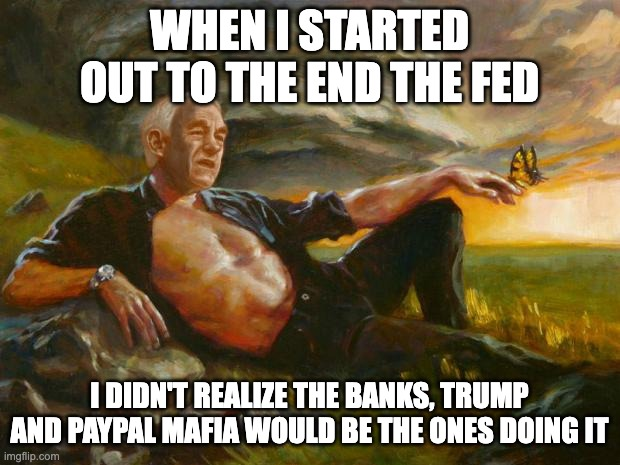
By day one nobody is ending anything; the ambition has already inverted, the same paper Bitcoin-adjacent rescue logic Episode 68 rests on — “Instead of End The Fed, lets work on keeping the Fed solvent.” — @bitcoin_bugle, 2024-05-24. The abolitionists, on this reading, are the crossed-purposes evangelists who approach the End The Fed crowd not to enlist them but to onboard them: “We saw you across the bar. Really digging your End The Fed t-shirt. Can we show you how to download a lightning wallet and send you some free Bitcoin?” — @bitcoin_bugle, 2024-11-27

The economy is fine
The Powell-put running gag — the load-bearing shared border with storylines/everything-is-fine — is worked hardest on the timeline. The half-point cut is filed as reassurance rather than alarm: “you still need proof that the economy is fine, anon?” — @bitcoin_bugle, 2024-09-23. When markets fall anyway the fault is inattention: “why is the market tanking? didn’t anyone watch the fed podcast yesterday? j pow said the economy is fine!” — @rodpalmerhodl, 2024-12-19. And the price is retrofitted to the policy after the fact — “bitcoin’s price rise was just waiting for good inflation data so the fed can continue rate cuts” — @rodpalmerhodl, 2024-12-11.
Bullying it, not ending it
This is the thesis in its native habitat. The accounts frame Bitcoiners as the party doing the pressuring, and the Fed as the party being domesticated: “congrats, you 58k gang pilled the Fed” — @rodpalmerhodl, 2025-04-06. Where the show has Alden nominated for Treasury, the timeline goes further and staffs the Fed itself — “get rid of j powell and put ron paul or saifedeen in charge of the fed” — @rodpalmerhodl, 2025-02-09 — Ron Paul and Saifedean installed as Fed chair, which is the LARP paradox stated before its name existed: not ending the institution, applying for it. Tether, meanwhile, is cast as the counterparty that negotiates policy directly: “Tether will negotiate lower interest rates from the Fed this week” — @rodpalmerhodl, 2024-08-05. Even the conference circuit closes the loop, chanting abolition and the dollar in one breath: “End the Fed! Bitcoin + Tether will change the world.” — @_podconf, 2025-04-22
Chairs, Jekyll Island, and the theory of everything
The late-arc move — the Fed as universal solvent — shows up on the timeline too. The Trump-vs-Powell feud resolves into an abolition-by-obsolescence pun: “We don’t need Chairs at the Fed. We have Bitcoin.” — @bitcoin_bugle, 2026-01-12
And the institution gets folded into the era’s other holy war — the OP_RETURN fight — with the full conspiracy stack invoked: “the bilderbergs and rothschilds have arrived at jekyll island with the fed governors. jerome powell has signaled his commitment to print as much money as necessary to fill every block with arbitrary data via op_return” — @rodpalmerhodl, 2025-10-03.
The Fed Siren (the other Fed)
Henry’s note: the accounts run a second “Fed” in parallel — the g-man sense, not the monetary one — and the collision is deliberate. The “Fed Siren” is an alarm sounded whenever a suspected federal agent speaks: “We’re banned from most Bitcoin Spaces for doing the “Fed Siren” anytime a fed is speaking” — @bitcoin_bugle, 2024-10-08. Rod supplies the demonstration reel the same day — @rodpalmerhodl, 2024-10-08. It belongs here only as pun-adjacent to the Federal Reserve arc, not as a monetary beat.
Disputed
The seeded version of this page bounded the storyline to 2023-09 through 2023-11 and described it as a four-article news arc: Powell failing to be Volcker, the Custodia case, the Federal Reserve hiring Barbra Streisand as brand manager, and the Fed suing Ron Paul for copyright infringement. Those four pages exist and are cited below as related reading.
The beat record contradicts the framing. Coverage for this slug is complete, and it runs 2024-05-06 to 2026-06-30 across fifteen episodes — no beat touches Custodia, Streisand, the Volcker comparison, or the Ron Paul suit. Ron Paul appears once in the whole spoken record of this arc, and as a DOGE appointee rather than a defendant.4 The span has been corrected accordingly.
Both readings can be true: the 2023 news items are the storyline’s paper record, the 2024–2026 episodes its spoken one, and they simply do not overlap. What the seed got wrong was treating the news headlines as the arc’s whole extent — and, in doing so, missing the turn that makes the storyline worth a page, which is the show deciding that the Fed’s most reliable defenders are Bitcoiners.
Paper record, unadvanced by any beat: Jerome Powell Still Not Paul Volcker (2023-09-20) · Custodia v. Federal Reserve Definitive Analysis (2023-09-21) · Federal Reserve Hires Barbara Streisand as Brand Manager (2023-11-03) · Federal Reserve Sues Ron Paul For Copyright Infringement (2023-11-03).
Footnotes
-
Bugle Weekly 68 @ 0:28. The sentence’s first two words (“No longer”) sit in the preceding cue. ↩
-
Bugle Weekly 7 @ 20:18. Quote continues across the next two cues. ↩
-
Bugle Weekly 27 @ 1:51. Quote spans two cues (t=111, t=114); the “collect” restatement is at t=126 and Greaser’s decode at t=242. ↩
-
Bugle Weekly 34 @ 40:49. Quote spans two cues (t=2449, t=2453); the day-one line is at t=2460 and the oddsmaking at t=2481–2496. ↩ ↩2
-
Bugle Weekly 36 @ 30:52. ASR spells her “Lynn Alden” here. Rod’s qualification — “who just understands Macroswell Sonalban” (t=1858–1860) — is mangled beyond recovery. ↩
-
Bugle Weekly 45 @ 27:30. Quote spans cues t=1650/1656; escalation at t=1667–1685; Greaser’s “biggest loser” at t=1539. ↩
-
Bugle Weekly 83 Part 1 @ 5:56. Setup at t=352; the “nothing stops this train” payoff at t=360. ↩
-
Bugle Weekly 68 @ 17:52. Built from the Iran/Carlson headline at t=1009–1061; the Iranian president is never named. ↩
-
Bugle Weekly 68 @ 34:49. Greaser’s charge that Brock “is pleading with people to sacrifice their children to Moloch right now” is at t=2081. ↩
-
Bugle Weekly 70 @ 15:30. Beat carries medium confidence; Rothbard is named at t=949, and “begging the fad to cut rates” is ASR for “the Fed.” ↩
-
Bugle Weekly 83 Part 2 @ 8:34. Complications at t=522–527; the petri-dish line at t=531–536 (“pep slop” is ASR). ↩
-
Bugle Weekly 100 @ 25:47. Greaser’s Antichrist premise at 25:25; Rod’s “the Powell put is bringing Jesus back” at 25:37. ↩
-
Bugle Weekly 104 @ 47:11. Quote spans 47:11–47:14. ↩
-
Bugle Weekly 111 @ 21:16. ASR renders “n word” as “inward” from 21:13 onward. ↩
-
“With Me Now” @ 0:23. Beat carries medium confidence; the quote sits mid-cue in a long verse cue, and no agency is named. ↩
-
Bugle Weekly 111 @ 52:10. Rod’s interjection at 52:16; the “bloody paper Bitcoin summer” line at 51:36. ↩
-
Bugle Weekly 115 @ 40:19. Fundamentals coins the name at t=2422; built from t=2398 and t=2412, with Greaser’s aside at t=2402. ↩